
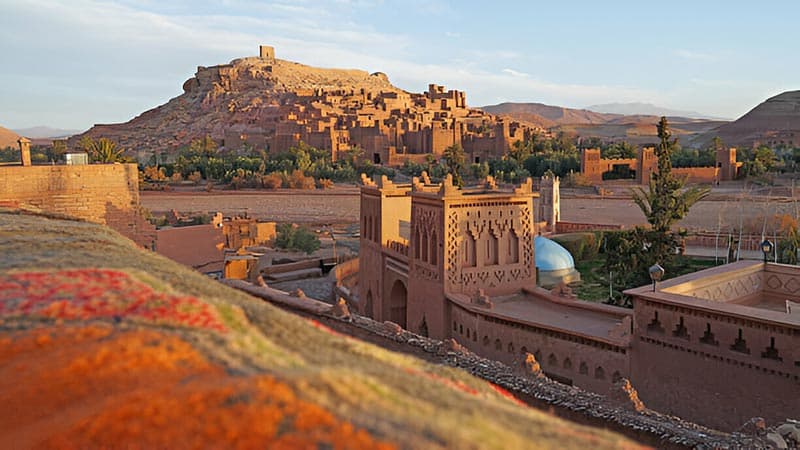
What kasbah means, how it differs from a ksar, how the earthen kasbahs of the south were built, and where to see the best ones.
A kasbah is a fortified building. In Moroccan cities it is the walled citadel of the old town, like the Kasbah of the Udayas in Rabat or the kasbah quarters of Tangier and Marrakech. In the south it is the high earthen fortress-house of a powerful family, with corner towers and decorated walls, like the Taourirt Kasbah in Ouarzazate. A ksar is different: a whole fortified village, and Ait Benhaddou is the best-known example.
This guide explains the difference between a kasbah, a ksar and a granary, how the earthen kasbahs were built, and where to see them on the road south of Marrakech.
A fortress or citadel; in southern Morocco, a fortified family house.
In the imperial cities the kasbah was the fortified seat of power inside the walls: the Kasbah of the Udayas above the river in Rabat, the kasbah of Tangier above the medina, and the Kasbah quarter of Marrakech around the Saadian Tombs. South of the High Atlas the word means something more personal: the fortified residence of a leading family, built to protect people, harvests and animals along the old caravan routes.
A kasbah protects one family, a ksar a whole village, and an agadir a village's grain.
A ksar (plural ksour) is a fortified village enclosed by one wall, with houses, a mosque and a single gate; Ait Benhaddou, a UNESCO World Heritage site, is a ksar, not a kasbah. An agadir (plural igoudar) is a fortified communal granary, found mostly in the Anti-Atlas. The table compares the three.
| Criterion | Kasbah | Ksar | Agadir (granary) |
|---|---|---|---|
| What it protects | One powerful family, or a city's rulers | A whole village | A village's grain and valuables |
| Layout | A tall house or citadel with corner towers | Many houses, a mosque and a gate inside one wall | Small storage rooms, one per family |
| Where | City citadels; the Dades, Draa and Ouarzazate area | The south, along the old caravan routes | Mostly the Anti-Atlas |
| Best example | Anti-Atlas villages |
From rammed earth and mud brick, with straw for strength, on stone foundations.
Walls are made of earth pressed between wooden boards (rammed earth, or pisé) and of sun-dried mud bricks, so the buildings take the colour of the land around them. Four corner towers, small windows and walls decorated with geometric patterns near the top are the signature of a southern kasbah. Earth needs constant care: when a kasbah is abandoned, rain slowly wears it down, which is why many stand half ruined beside restored ones.
The route from Ouarzazate east through the Skoura oasis and the Dades Valley, lined with earthen kasbahs.
The road follows the Dades Valley between the High Atlas and the Jebel Saghro, past the Valley of Roses around Kelaat M'Gouna. In the Skoura oasis, the Kasbah Amridil is the one shown on the 50 dirham note. Every desert tour from Marrakech drives part of it.
Taourirt in Ouarzazate, Telouet on the old Tichka road, Amridil in Skoura, and the ksar of Ait Benhaddou.
The Taourirt Kasbah in Ouarzazate was a Glaoui family residence, a maze of rooms and courtyards. The Telouet Kasbah, former palace of Thami El Glaoui, hides decorated zellige halls behind crumbling earth walls. Kasbah Amridil in Skoura is restored and furnished as a museum, and Ait Benhaddou, a short detour from the Tichka road, is the best-known ksar in Morocco.
The Tizi n'Tichka pass, the Telouet Kasbah and the ksar of Ait Benhaddou in one day. From $110 per person for two.
See the tourAit Benhaddou, the Dades Valley and a night in the Sahara. From $395 per person for two.
See the tourKasbah Amridil in Skoura and a night facing Ait Benhaddou at sunset.
See the tourA fortified building: the walled citadel of an old city, or in the south the earthen fortress-house of a powerful family, with corner towers and decorated walls.
A kasbah protects one family or a city's rulers; a ksar is a whole fortified village with many houses inside one wall. Ait Benhaddou is a ksar.
It is a ksar, a fortified village, though it contains kasbah-style houses. It is a UNESCO World Heritage site on the old caravan route over the High Atlas.
East of Ouarzazate, through the Skoura oasis and the Dades Valley. Every desert tour from Marrakech drives part of it.
Rammed earth and sun-dried mud bricks with straw, on stone foundations, which is why they share the colour of the land around them.