
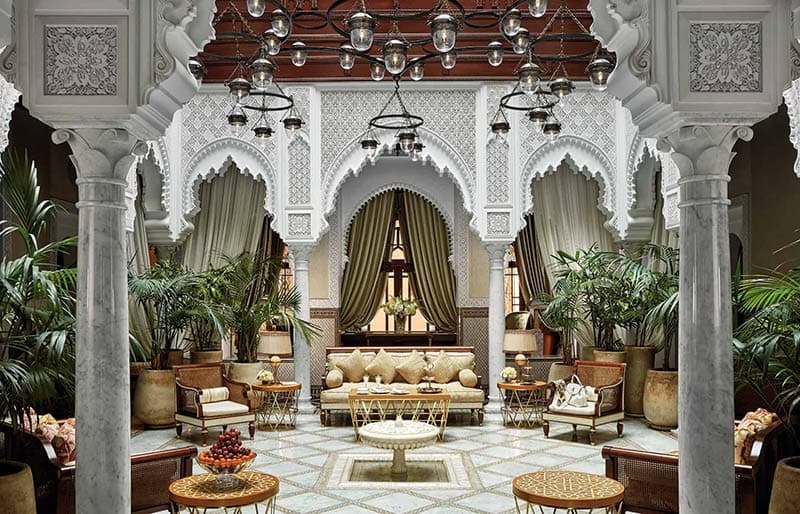
What the word means, what a riad looks like inside, how it differs from a dar or a hotel, and what to expect when you stay in one.
A riad is a traditional Moroccan house built around an inner courtyard or garden, with its rooms opening onto the courtyard and plain outer walls facing the street. The word comes from the Arabic for garden. Today most riads in the old medinas of Marrakech, Fes, Chefchaouen and Essaouira are small guesthouses, which is why "riad" also means a boutique hotel in an old house.
This guide explains what a riad is, how it differs from a dar and from a hotel, and what to expect when you stay in one. Most nights on our city routes are spent in riads, so the examples are the ones our guests stay in.
Riad comes from the Arabic word for garden; it describes a house built around a planted courtyard.
A classic riad has a central garden, often divided into four planted beds around a fountain, open to the sky. A dar is the simpler version: a house around a courtyard, usually tiled, without the garden. In everyday Moroccan usage, and on booking sites, both are now often called riads. Short definitions of riad, dar and related words are in our Moroccan travel glossary.
A courtyard with a fountain or plants at the centre, rooms on two or three floors around it, and a roof terrace on top.
From the street a riad is a plain wall with a heavy door. Inside, everything faces the courtyard: zellige tilework, carved plaster and cedar wood, and polished tadelakt plaster on the walls. Rooms are reached by stairs and open galleries, and the roof terrace is where breakfast is often served, with views over the medina. Some riads have a small plunge pool in the courtyard.
A riad for atmosphere and walking distance to the medina; a hotel for lifts, large pools and door-to-door car access.
The table compares the two. Families with small children, travellers with limited mobility and anyone who wants a big pool usually prefer a hotel in Gueliz or Hivernage in Marrakech; first-time visitors who want to step straight into the medina usually prefer a riad.
| Criterion | Riad | Dar | Hotel |
|---|---|---|---|
| Layout | Rooms around a planted courtyard garden | Rooms around a tiled courtyard, no garden | Modern building, rooms on corridors |
| Location | Inside the medina | Inside the medina | Usually outside the medina (Gueliz, Hivernage, Palmeraie) |
| Size | A handful of rooms | Smaller still | Dozens to hundreds of rooms |
| Car access | To the nearest gate, then on foot | To the nearest gate, then on foot | To the door |
| Pool | Sometimes a small plunge pool | Rarely | Often a large pool |
| Best for | Atmosphere, first visits, couples | Budget stays in the medina | Families, limited mobility, resort stays |
Few rooms, personal service, quiet evenings and a walk from the nearest gate.
Riads have a handful of rooms, so staff know your name and can book a hammam or a dinner for you. Sound travels around the open courtyard, so evenings are quiet, and some riads ask guests to take their shoes off indoors; the house rules are covered in Moroccan hammam, riad and souk etiquette. Cars cannot drive into the deepest lanes of the medina, so your driver stops at the nearest gate and a porter or the riad staff walk you to the door.
In the old medinas: Marrakech, Fes, Chefchaouen, Essaouira, Rabat and Tangier.
These are the riads our tours use. In Marrakech: Riad Kniza and La Maison Arabe, and La Villa des Orangers on our luxury routes. In Fes: Riad Fes (Relais & Châteaux), Palais Amani and Riad Karawan. In Chefchaouen: Lina Ryad & Spa and Dar Echchaouen. In Rabat: Riad Dar El Kebira. Our Marrakech itinerary compares the areas of Marrakech to stay in.
Riads in Rabat, Fes and Marrakech. From $1,090 per person for two.
See the tourRelais & Châteaux riads and palace hotels every night.
See the tourTwo nights each in riads in Chefchaouen and Fes.
See the tourA traditional house built around an inner courtyard or garden, with rooms opening onto the courtyard. Most riads in the medinas are now small guesthouses.
A riad has a planted courtyard garden, from the Arabic word for garden; a dar is a house around a simpler tiled courtyard, usually smaller. Both are often called riads today.
A riad if you want atmosphere and to walk straight into the medina; a hotel if you need a lift, a large pool or a car to the door, which suits families with small children.
Usually not at the door: cars cannot drive into the deepest medina lanes, so drivers stop at the nearest gate and the riad sends someone to walk you in.
Some have a small plunge pool in the courtyard; for a large pool, choose a hotel outside the medina.